- Can it be fixed?
- Usually – especially stitched or welted boots with healthy uppers.
- Safe to fix yourself?
- Not realistic. A proper resole means removing the old sole, then attaching and finishing a new one.
- What decides the cost?
- Construction, the sole you choose, heel work, damage under the sole, and boot style.
- Mail it in?
- Yes, from anywhere in the US.
- While you wait?
- Some small repairs, yes. Call ahead.
Which problem is it?
Check the bottom, the edge of the sole and the leather to see where your boots stand.
Worn through at the ball
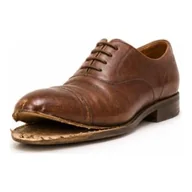
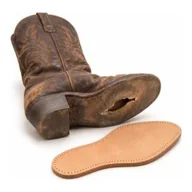
A hole or thin spot under the ball of the foot, or tread worn smooth, means the sole has done its job. If the leather and the stitching above the sole are sound, this is the classic case for a full resole.
Heel worn down at the back
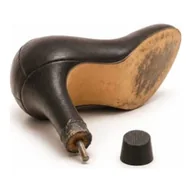
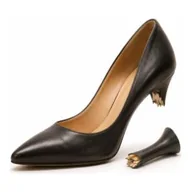
Cowboy boots and work boots often wear the back corner of the heel first. If it’s caught before the wear eats deep into the heel, the heel can be replaced along with the sole so the boot sits level again.
Stitched or glued boots
Look at the edge where the sole meets the boot. A visible row of stitching around a welt usually means the boot was built to be resoled. A smooth glued seam can often take a new sole too, but the options depend on how it was made.
Leather cracked or split
Deep cracks across the flex point, splits at the seams, or leather that is dry and brittle all over are the warning signs. A new sole won’t fix the leather, so this is what decides whether a resole is worth it.
What to do right now.
- Stop wearing them as soon as you see a hole or feel the ground through the sole.
- Brush off mud and dirt, and let wet boots dry slowly at room temperature.
- Photograph the bottoms, the heels, the side edge where the sole meets the boot and any cracks in the leather.
What not to do.
- Don’t glue a rubber patch or a stick-on sole over a hole, because it has to be stripped off before a proper resole.
- Don’t dry soaked boots by a heater or with a hair dryer, which can shrink and crack the leather.
- Don’t throw out a pair you love just because the soles are gone; check the leather first.
When it’s not worth repairing.
Resoling usually isn’t worth it on inexpensive boots with a molded sole bonded on as one unit, since the work can cost close to a new pair. It also doesn’t make sense when the leather is cracked through, dry and splitting everywhere, or the boots never fit you well. A new sole can’t fix any of those.
How we fix it.
- We check the construction, the leather, the welt or edge and the heels, and tell you honestly if a pair isn’t worth resoling.
- We go over the sole and heel options for how you use the boots, then remove the worn sole and heel.
- A new sole and heel are attached, and the edges are trimmed and finished.
- If you’d like, the leather can be cleaned and its color restored so the uppers look as good as the new soles.