- Can it be fixed?
- Usually – if the sole itself isn’t cracked or worn through.
- Safe to fix yourself?
- Not recommended. Household glues stay stiff, crack, and make a proper repair harder.
- What decides the cost?
- Glued or stitched sole, how far it has separated, the materials, and whether the sole needs replacing.
- Mail it in?
- Yes, from anywhere in the US.
- While you wait?
- Some small repairs, yes. Call ahead.
Which problem is it?
Where and how the sole is separating tells you a lot about the fix.
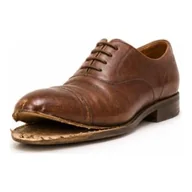
Toe starting to lift
The front edge often peels up first because it bends with every step. Caught early, with a small gap and a sole that still has tread, this is usually a straightforward reattachment.
Sole flapping when you walk
A gap along the side that opens with each step means the bond has failed over a large area. The old adhesive has to be cleaned off both surfaces before the sole can go back on.
Stitched sole coming apart
On stitched shoes and boots, look at the thread along the edge of the sole. If it has worn or broken, glue alone won’t hold for long. The sole needs to be stitched again or replaced.
Sole cracked or worn through
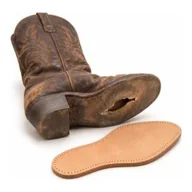
A crack across the bottom or a hole under the ball of the foot means the problem is the sole itself, not the bond. That calls for a new sole rather than a reattachment.
What to do right now.
- Stop wearing the pair until it’s fixed, because every step pushes the gap further open.
- If you have to walk back to your car or hotel, hold the sole in place with a rubber band so it doesn’t catch and fold under.
- Keep any piece that has fallen off in a small bag with the shoes.
- Take photos of the whole shoe, the bottom and a side close-up of the gap.
What not to do.
- Don’t use super glue or household glue, which goes brittle, cracks within a few steps and leaves residue that has to be removed before a proper repair.
- Don’t keep walking on a flapping sole, because it can tear the stitching or the upper along the edge.
- Don’t dry wet shoes with a hair dryer or next to a heater, since heat weakens adhesive and dries out leather.
When it’s not worth repairing.
If the shoes were inexpensive and the sole is a foam or molded unit that is crumbling, splitting or worn through, a repair can cost close to a new pair, and replacing them usually makes more sense. The same is true when the upper is torn right where it meets the sole, because there’s nothing solid left to attach to.
How we fix it.
- We check how the sole was attached – glued, stitched or both – and look at the sole and the upper around the gap.
- For a glued sole, we clean off the old adhesive, prepare both surfaces and bond the sole back under pressure.
- If the stitching has failed or the sole is worn out, we explain the options, including a new sole, before any work starts.