- Can it be fixed?
- Usually, on genuine leather. Bonded or faux leather is much harder to repair well.
- Safe to fix yourself?
- Only for light tooth marks. Glue and kits on tears usually make a pro repair harder.
- What decides the cost?
- Size and number of bites, where they are, leather type and color, and whether a panel is needed.
- Mail it in?
- Not for furniture or car seats. Pickup and delivery are available for larger pieces.
- While you wait?
- Some small repairs, yes. Call ahead.
Which problem is it?
Pet damage on leather furniture usually looks like one of these:
Tooth marks and surface scratches
The leather is dented, scuffed or scratched but not torn through. This is the mildest case. Cleaning, color matching and refinishing can often make light marks much less visible, especially on darker colors.
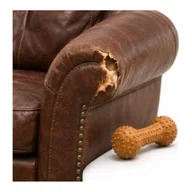
Chewed arm, edge or corner
Dogs often go for cushion corners, piping and the front of the arms. If the leather is ragged but mostly still there, it can usually be repaired and patched in place, then color-matched. Curved spots like piping take more care.
Hole with leather missing
If a piece was bitten off and lost, there’s nothing to reattach. Small holes can often be patched. Larger holes, or damage that runs across a seam, may need a new leather panel for that section, color-matched to the rest of the couch.
Cushion torn open, foam showing
When a chew goes through a seam or the leather, the foam underneath may be torn or pulled out too. The leather can be patched or re-stitched, but mention any foam damage when you send photos so we can tell you what’s possible.
What to do right now.
- Keep your dog off the couch, or cover the damaged spot with a blanket, so the chewing doesn’t spread.
- Save any chewed-off pieces of leather you find, even small ones, because they show the original color and finish.
- Photograph the whole couch, then each damaged spot up close with a coin next to it for scale.
- Look for a tag under the cushions or the frame that says “genuine leather,” “bonded leather” or “PU,” and photograph it too.
What not to do.
- Don’t trim the ragged edges with scissors, because that leather is often needed for the repair.
- Don’t fill tears with super glue or DIY kit filler; it hardens and makes a clean patch much harder.
- Don’t spray chew-deterrent products straight onto the leather without testing a hidden spot first, since some can stain or leave a sticky film.
When it’s not worth repairing.
If the couch is bonded or faux leather, or the chewing is spread across most of the cushions, arms and back, repairs can add up to more than a new couch – and patches on bonded leather won’t stop it from peeling later. If your dog is still in the chewing phase, it can also make sense to wait before repairing.
How we fix it.
- Text photos to (702) 622-0659 for a free estimate. We’ll tell you honestly how close to invisible the repair can get on your couch.
- For larger pieces, call to arrange pickup and delivery; charges may apply depending on your area.
- We repair torn areas, patch holes and, where needed, fit new leather panels. Then we color-match and refinish so the repair blends with the rest of the couch.