- Can it be fixed?
- Usually – small holes, cuts and split seams repair well; missing leather may need a new panel.
- Safe to fix yourself?
- Cover it to stop the spread; glue, tape or kit filler in the hole makes a clean patch harder.
- What decides the cost?
- Size and shape of the tear, missing leather, seam or foam damage, perforations and color.
- Mail it in?
- Not for furniture or car seats. Pickup and delivery are available for larger pieces.
- While you wait?
- Some small repairs, yes. Call ahead.
Which problem is it?
Look closely at the damage and match it to one of these:
Small hole or puncture
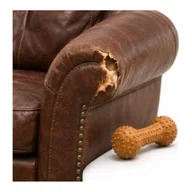
Keys in a back pocket, a tool, a buckle or a pet’s claw can punch a small hole in the seat. If the leather around it is still soft and whole, it can usually be patched and color-matched so it’s much less noticeable.
Clean cut or slit
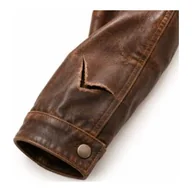
A straight slit from a box cutter or something sharp in a bag usually has clean edges and no leather missing, so it tends to close up neatly. The longer the cut, and the closer it runs to a seam or a curve, the more care it takes.
Seam split open
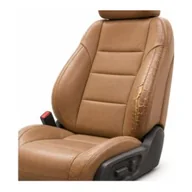
If the stitching gave way but the leather on both sides is whole, the seam can usually be re-stitched. If the leather tore along the stitch holes, that edge needs repair or a new panel first. Seams on the seat cushion take the most strain.
Tear that keeps spreading
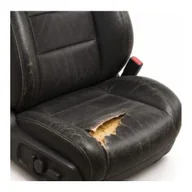
A tear on the seat cushion that has grown, with foam showing or leather missing, is the most serious case. Leather dried out by the Las Vegas sun tears faster. Small sections can sometimes be patched; larger damage usually means a new leather panel for that section.
What to do right now.
- Cover the tear with a towel or seat cover so it doesn’t snag on clothes and keep growing.
- Take keys and tools out of your back pockets before you sit, and keep sharp things off the seat until it’s repaired.
- Photograph the whole seat, then the tear up close with a ruler or tape measure beside it, and note your car’s make, model and year.
- Tell us if the seat is perforated, heated or cooled, because that affects how the repair is planned.
What not to do.
- Don’t pull or snip loose threads at a split seam; that can unravel more of the stitching.
- Don’t put duct tape on the leather, because the adhesive leaves a sticky residue that has to come off before any repair.
- Don’t super-glue the edges of a tear together; the glue hardens, cracks every time you sit, and has to be removed first.
When it’s not worth repairing.
If tears show up on several seats, the leather around them is brittle and cracking all over, and the car is worth little, patching every spot may cost more than it’s worth – a seat cover or a used seat can make more sense. One tear on an otherwise soft, healthy leather seat is different: that’s usually worth fixing before it spreads.
How we fix it.
- Text photos of the tear and the whole seat to (702) 622-0659 for a free estimate. Then call (702) 553-3273 to talk through the next step for your car, including whether pickup and delivery make sense.
- Small holes and cuts are repaired and patched, and split seams are re-stitched.
- We’ve repaired torn leather car seat cushions. Where leather is missing or the tear is too large, that section gets a new leather panel.
- Then we color-match and refinish the repaired area so it blends with the rest of the seat.